


Root canal that didn't work? A tooth can often be treated again.
A root canal that has failed is not always the end of the tooth. Retreatment opens the tooth again, removes the old filling, finds what was missed and cleans and seals it properly.
Retreatment is a second root canal on a tooth that was treated before. It is used when pain or infection returns, and it is often an alternative to extraction.
Examined under a microscope. Options and costs explained before any treatment.
Last updated 17 October 2026
Signs a root canal may have failed
- Pain or tenderness returning months or years after treatment
- Swelling, a gum boil or a bad taste near the tooth
- A dark area at the root tip on an X-ray
- A root canal that never fully settled after the first visit
- New decay or a leaking crown on a tooth that was treated
What happens, step by step
Look
We review your X-rays and examine the tooth to find out why the first treatment has not healed.
Explain
You hear whether retreatment, a small surgery or extraction is the most sensible route, with costs.
Re-clean
We take out the old filling material, search for missed canals under the microscope and clean the whole system.
Rebuild
The tooth is sealed again and rebuilt, with a new crown if the old one cannot be kept.
Why root canals fail, and why we can often fix it
The usual reasons are a canal that was missed, a canal that was not fully cleaned, new decay getting in, or a crack. Many of these can be found and put right once the tooth is reopened and seen clearly.
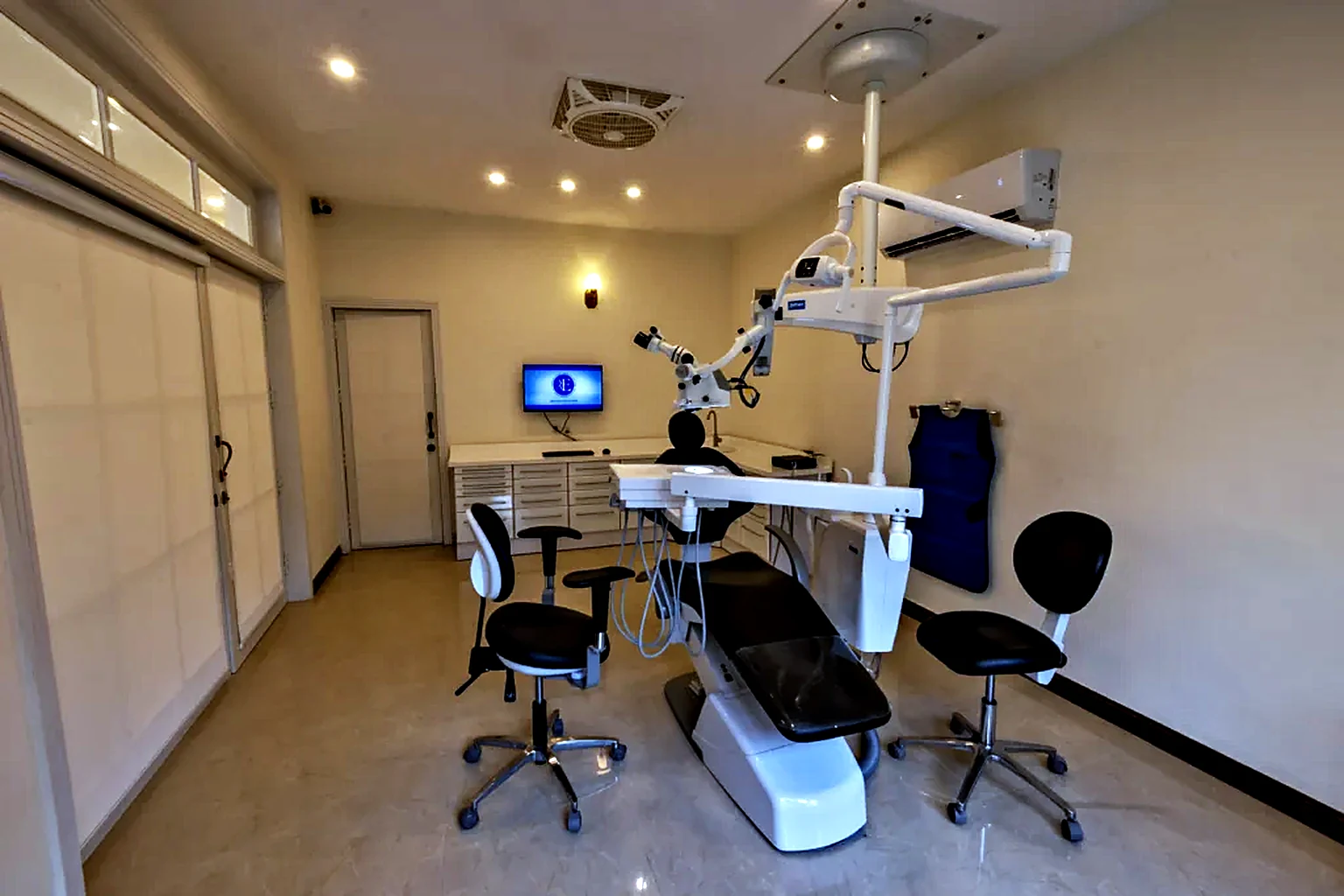
Under a surgical microscope we can see the floor of the tooth, follow hidden canals and clear old material that the naked eye cannot judge. That is why retreatment is a large part of Dr. Iqbal's work.
Retreatment, apicoectomy or extraction: how they compare
When a root canal has not healed, there are three routes. The right one depends on why it failed.
| Option | Suited to | Worth knowing |
|---|---|---|
| Retreatment | A missed or poorly sealed canal, or a leaking restoration | Usually tried first when the tooth is strong enough |
| Apicoectomy | Infection at the root tip that retreatment cannot reach | A small surgery. It is often chosen to keep a crown or post that should not be removed |
| Extraction | A split root, or too little healthy tooth left | Final, so it should follow a careful examination and a second opinion |
Questions patients ask
Why did my root canal fail years later?
Bacteria can re-enter through a leaking filling or crown, or through a canal that was never cleaned. The tooth can be quiet for a long time before it flares.
Is retreatment better than extraction?
When the tooth is strong enough, keeping your natural tooth is usually the better long-term option, but it depends on the tooth. We will go through both honestly.
Will I need my crown replaced?
Sometimes we can work through the old crown. If it has to come off, we will plan a new one before we begin.
What if retreatment is not enough?
An apicoectomy, a small surgery on the root tip, can treat an infection that retreatment cannot reach.
How long does it take?
Retreatment is usually longer than a first root canal. We explain the number of visits at your consultation.
You may also want to read
Apicoectomy
Root-tip surgery when infection remains after a root canal.
Read moreMicroscopic endodontics
Seeing inside the tooth clearly, so nothing is missed.
Read moreRoot canal treatment
Deep decay, a toothache that lingers, or a nerve that is infected.
Read moreExtractions
When a tooth cannot be saved, and how to be sure before it comes out.
Read more