
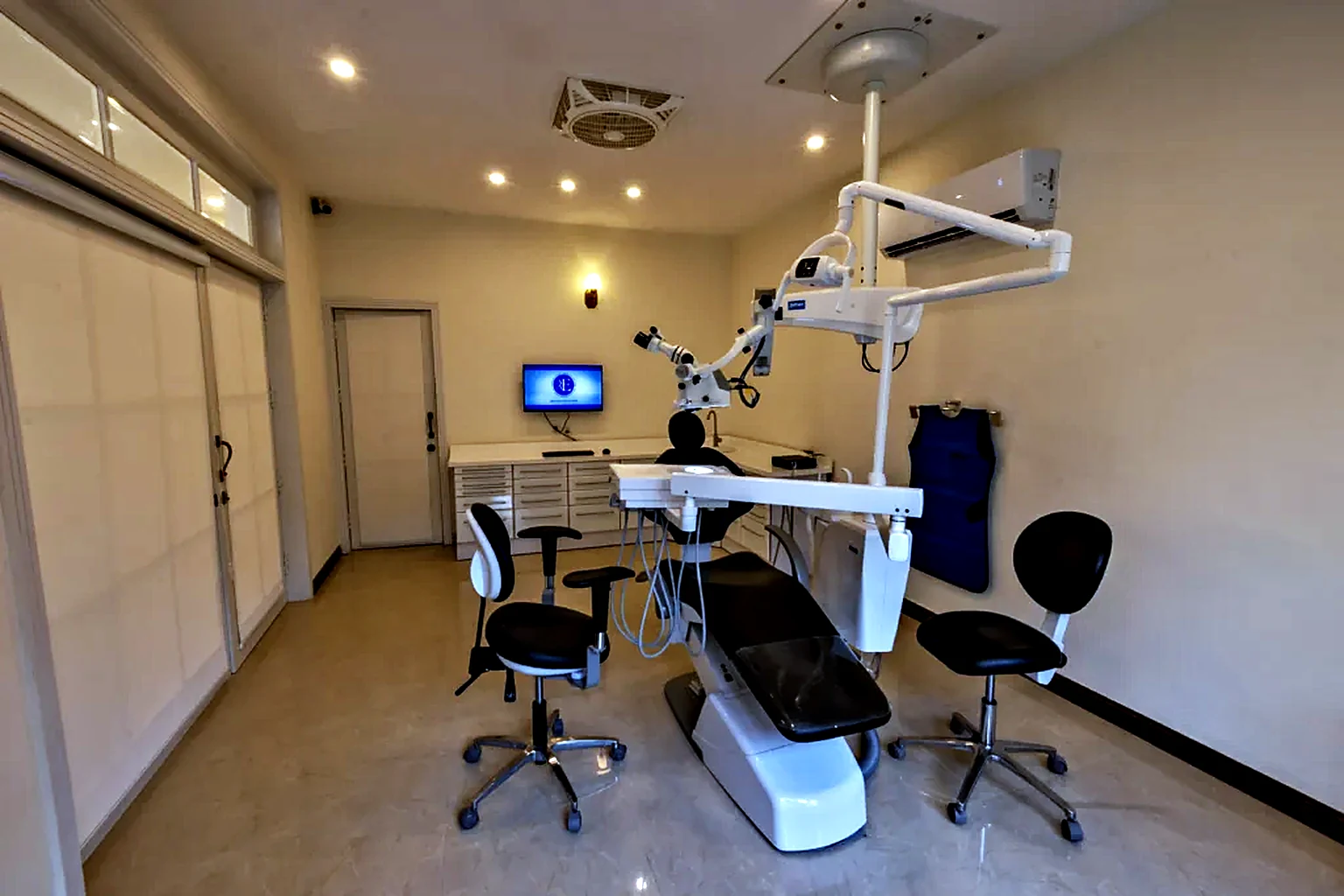


Why does a microscope matter for a root canal?
Because you cannot treat what you cannot see. A surgical microscope gives us light and magnification inside a tooth that is only a few millimetres wide.
A microscopic root canal is ordinary root canal treatment done with a dental operating microscope. It helps us find narrow or hidden canals, spot cracks and clean more thoroughly.
Examined under a microscope. Options and costs explained before any treatment.
Last updated 17 October 2026
Where the microscope makes the biggest difference
- Back teeth with several, narrow canals
- Retreatment, where old material must be removed and missed canals found
- Suspected cracks that are hard to see
- Calcified canals that have narrowed with age
- Apicoectomy, where the root tip must be seen and sealed precisely
What happens, step by step
Light
A coaxial light shines straight down the tooth, so there are fewer shadows.
Magnify
Magnification lets us see the floor of the tooth and the openings of the canals.
Clean
We work with finer control, preserving healthy tooth structure.
Check
Before sealing, we inspect the result and show you the X-rays.
The microscope is a tool. Training is what uses it well.
A microscope does not guarantee an outcome, and we would be wary of anyone who says it does. What it gives a trained endodontist is better information at every step.
Dr. Iqbal is a Diplomate of the American Board of Endodontics, and treats under a surgical microscope every day.
Root canal with and without a microscope
The aim of treatment is the same. What changes is how much can be seen.
| Without a microscope | With a surgical microscope | |
|---|---|---|
| View inside the tooth | Relies on touch, X-rays and loupes | Direct, lit and magnified view of the canals |
| Hidden or narrow canals | Easier to miss | Easier to find and follow |
| Cracks | Hard to see | Often visible, which changes the advice |
| Retreatment | Old material harder to judge | Old material can be seen and removed precisely |
Questions patients ask
Is a microscopic root canal different from a normal one?
The goal is the same. The difference is how clearly the dentist can see and work inside the tooth.
Does it cost more?
Fees depend on the tooth and the complexity of the case. We explain options and costs before treatment starts.
Will I see what the microscope sees?
We take X-rays during treatment and explain them to you in plain language.
Is it suitable for every tooth?
It can be used for any root canal, and is most useful for complex teeth, retreatment and surgery.
Is it more comfortable for me?
Treatment is under local anaesthetic either way. Better visibility often means more precise, more conservative work.
You may also want to read
Root canal treatment
Deep decay, a toothache that lingers, or a nerve that is infected.
Read moreRoot canal retreatment
A root canal that is sore again, infected again or never settled.
Read moreApicoectomy
Root-tip surgery when infection remains after a root canal.
Read moreCracked teeth
Pain on biting or a sharp zing that is hard to pin down.
Read more